Preserve raw evidence
Source records are immutable, traceable, and replayable. Mapping improvements replay from raw records rather than mutating them.
The Mulanous system
Mulanous preserves source evidence, maps business meaning, and challenges candidates before delivering a quantified action.
The shared system
Source records are immutable, traceable, and replayable. Mapping improvements replay from raw records rather than mutating them.
Candidates are untrusted and cannot reach users before scoring, deterministic counter-checks, Evidence Ladder, evidence evaluation, and actionability filtering.
Operators receive clear actions, managers receive exceptions, and executives receive quantified decision context. Each role preserves the same evidence and provenance.
Multi-vertical V1
Connectors, templates, and delivery surfaces are capability-ledger commitments, not claims that every integration is already live.
Two motions, one engine
Self-serve workflows apply validated standard patterns.
Engineers map tenant data and build reviewed, tenant-specific patterns with domain experts.
Both use one shared engine for ingestion, Nous, detection, delivery, feedback, and the Pattern Library.
Pattern Library
Authority stays gated
V1 recommends actions and records feedback. It does not write back to client systems. It does not execute business decisions. It does not automatically retrain models.
Truthful scope
Architecture
PostgreSQL remains the operational system of record. Immutable raw records flow through tenant-specific Nous metadata. The Go backend owns ingestion, authorization, deterministic validation, action construction, delivery, and feedback. The scoring service returns per-method scores, composite score, warnings, provenance, and explanation fragments; it does not decide actionability or delivery.
Architecture figure
Summary. Existing business data moves through immutable ingestion, PostgreSQL domain data, Nous metadata, four distinct detection stages, and role-specific delivery. Structured feedback returns through reviewed configuration to future detection without changing raw records.
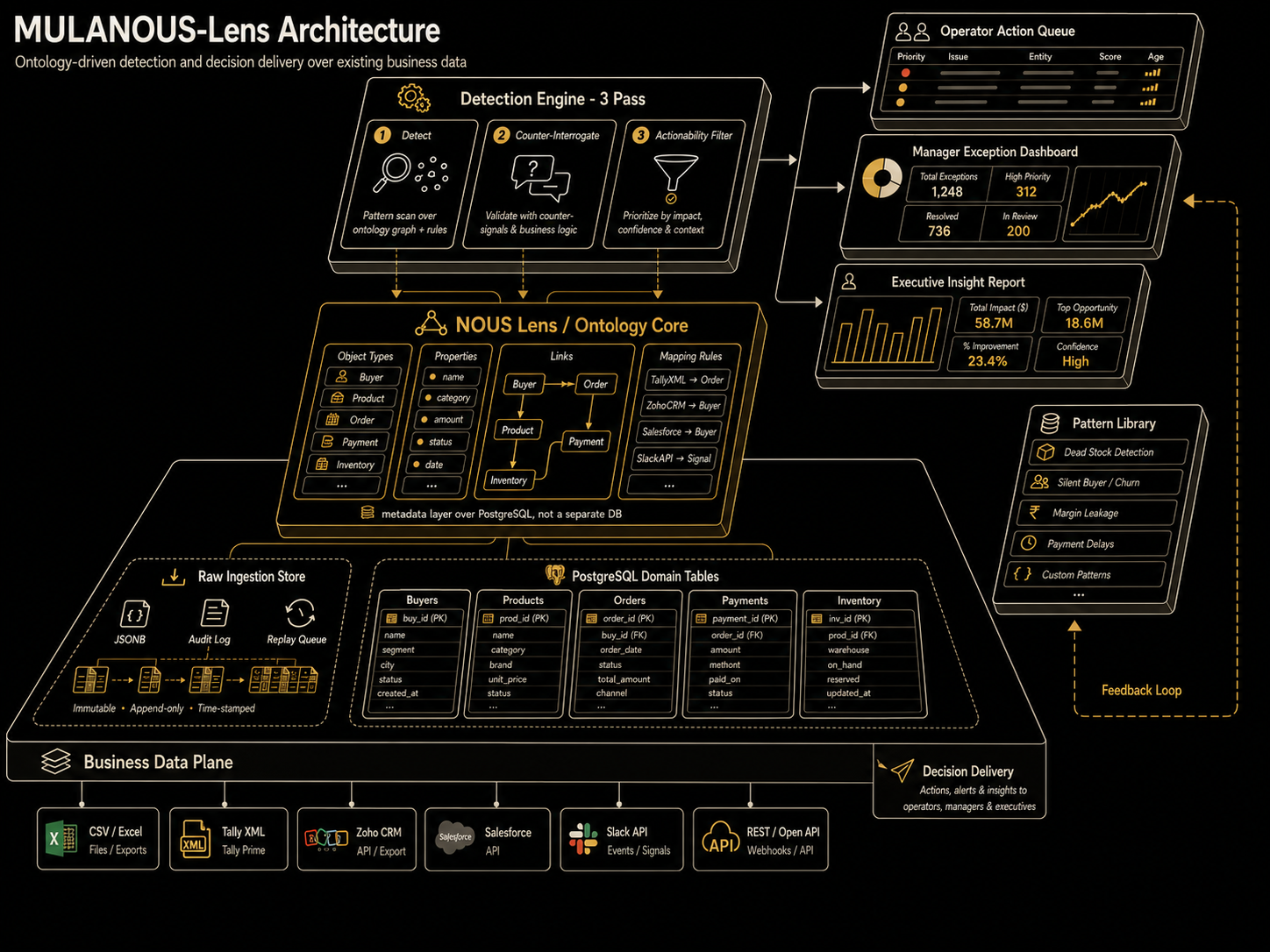
Architecture figure
Summary. Nous metadata maps PostgreSQL domain data into tenant-aware object instances. It is metadata over PostgreSQL, not a separate database, and improved mapping rules replay immutable raw records.
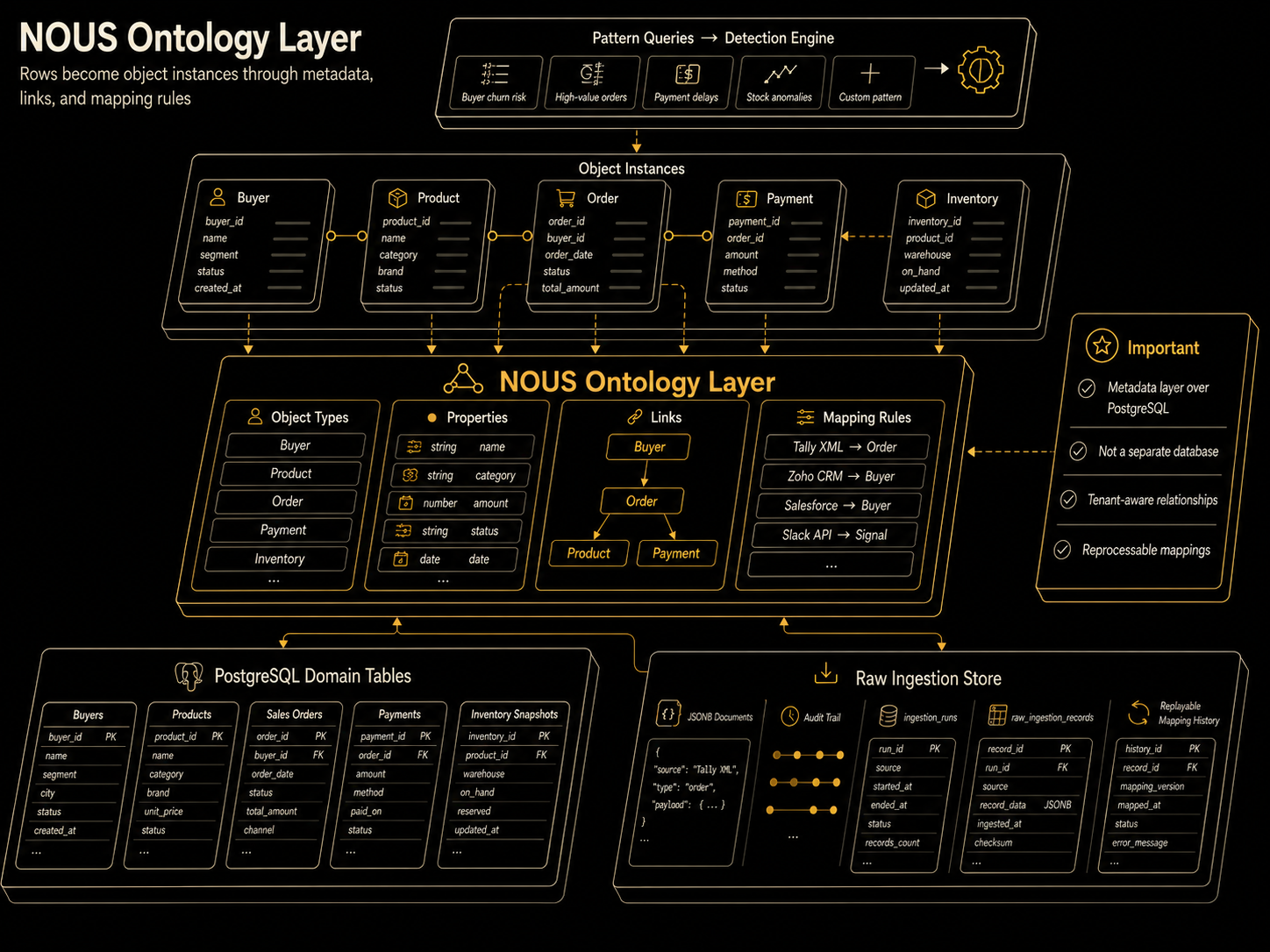
Tenant-aware relationships
Architecture figure
Summary. The Pattern Library produces untrusted candidates. Pass 2A scores them, Pass 2B tries to disprove them using deterministic checks and the Evidence Ladder, and Pass 3 prepares verified actions for the correct role.
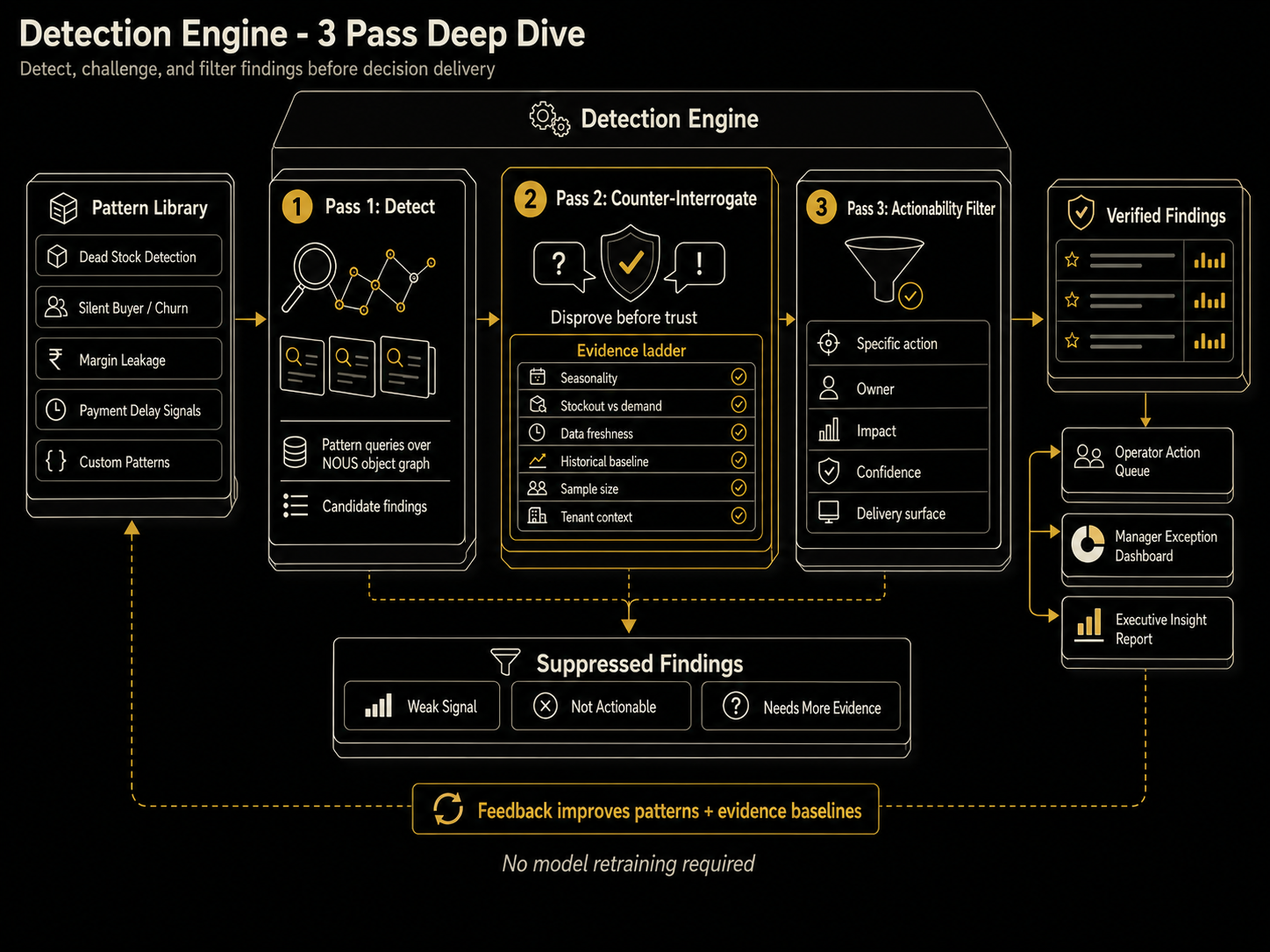
Architecture figure
Summary. One verified Pass 3 finding is filtered by role, adapted to the role's decision context, then routed through the client's configured delivery channel.
Architecture figure
Summary. Delivered findings collect structured human feedback that informs reviewed Pattern Library and Evidence Ladder configuration for future detection.
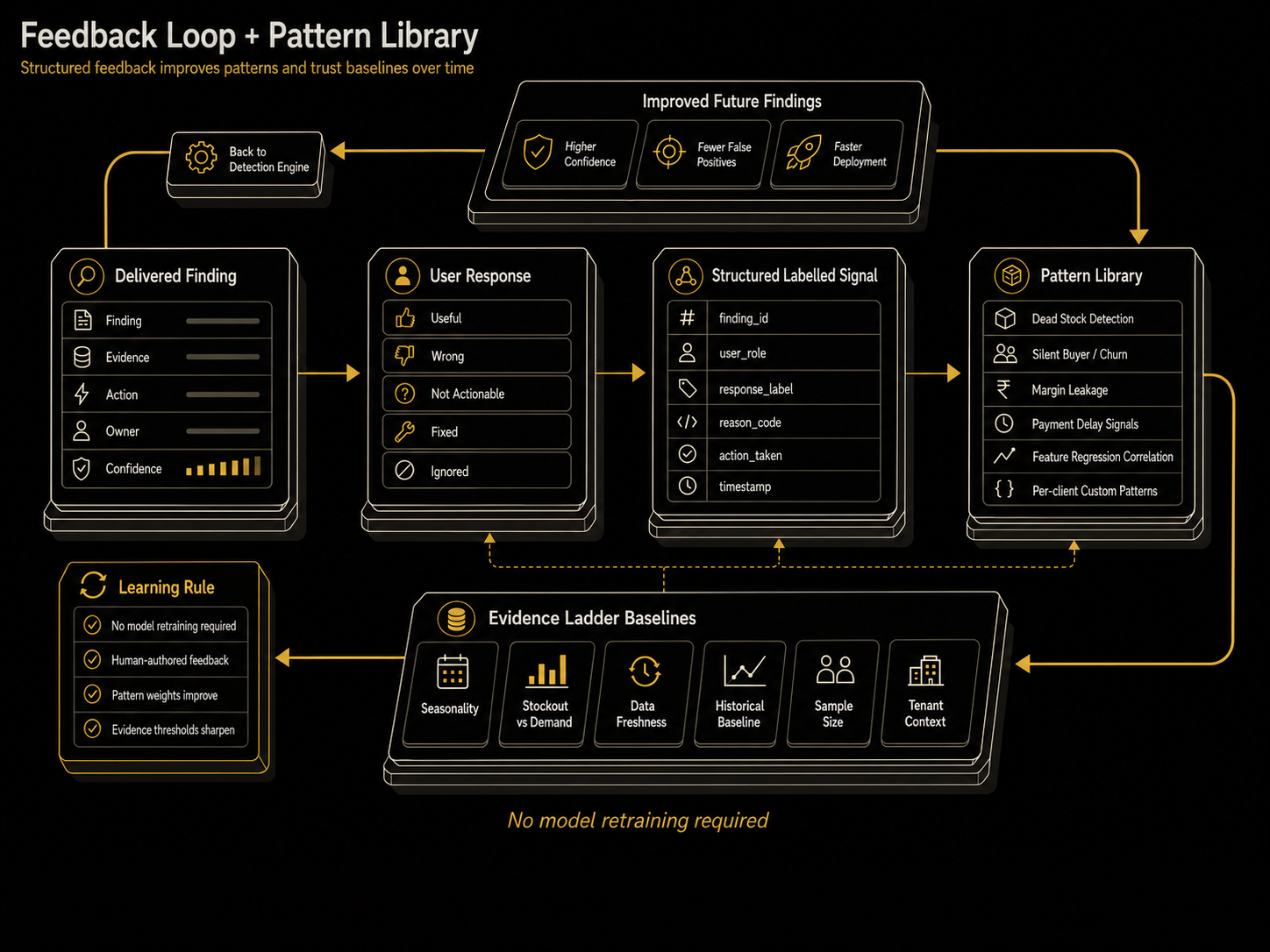
Finding, evidence, action, owner, and confidence.
FDE custom patterns
Engine-proposed candidate patterns
Data-gated: candidate-only until reviewed promotion.
Seasonality, data freshness, sample size, and tenant context.
Reviewed adjustment to pattern weights and evidence thresholds.
Feedback changes explicit, auditable configuration; it does not silently retrain models.
Architecture figure
Summary. Lens self-service and Forward Deployment use one Mulanous core. They differ in configuration depth and delivery scope, not architecture.
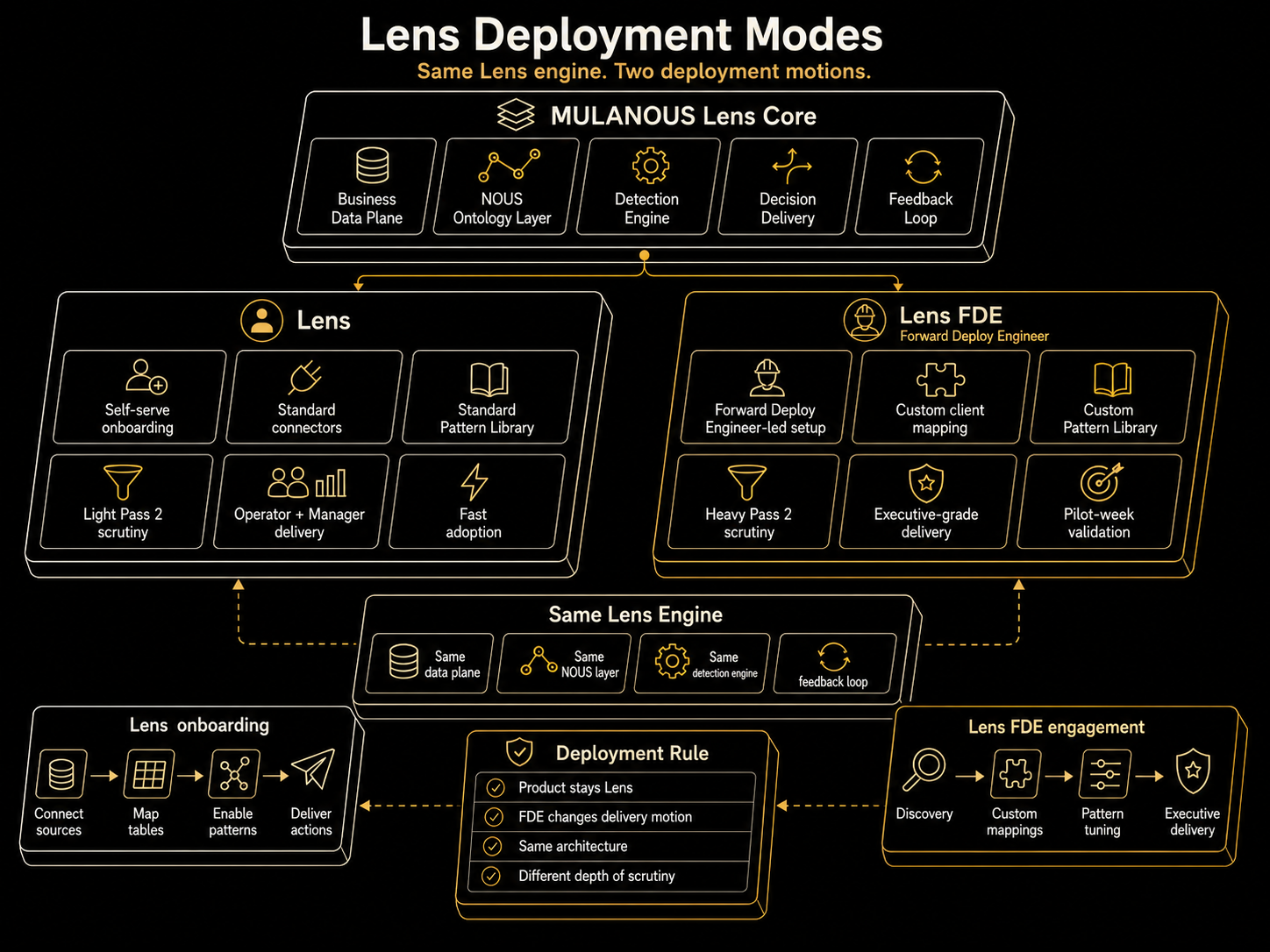
Shared data, Nous, detection, and feedback
Productized onboarding and proven standard patterns.
Engineer-led mapping, calibration, and reviewed custom patterns.
Start with a pilot
Forward Deployment is the first commercial proof and delivery motion. It validates the shared engine before Lens is productized.
Discuss a pilot